

Sainte Thérèse of Lisieux
A brief history of Sainte Therese of Lisieux, and her miracles
SAINTS
5/1/20266 min read
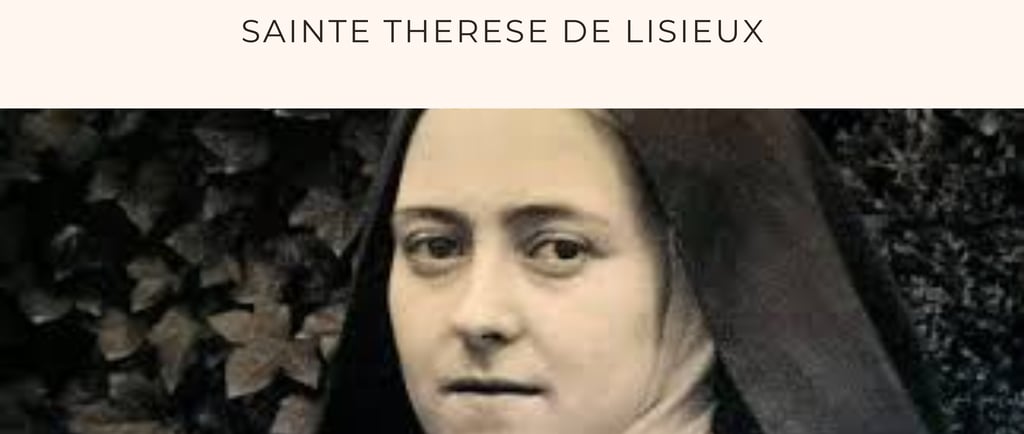
Who was Sainte Thérèse of Lisieux?
Years Ago, while a middle school student in France, I was lucky enough to visit Lisieux in Normandy (Calvados) France, although it was close to where my family was from I had never had a chance to visit this town until that point. During that pilgrimage we stayed at a convent a little outside the city, and were blessed to visit the convent Sainte Therese of Lisieux (and her sisters) had lived in, we saw her room, and many of her relics, at the time I did not realize how much of an impact this would have on my life other than "she was amazing I want to be as cool as her" (read that in the voice of a 13 year old girl baptized a year earlier). Today I am writing this post both to make the little girl i was 15 years ago, and as a homage to the Saint that has consistently helped bring me closer to God.
Sainte Thérèse of Lisieux 's story
Thérèse of Lisieux, born Marie Françoise-Thérèse Martin, is one of the most popular Catholic saints in modern history. Known affectionately as "The Little Flower," she is a Doctor of the Church (a title given to saints whose writings have significantly benefited the entire Church,despite dying at the young age of 24.)
Her life was defined by what she called the "Little Way," a spiritual path of seeking holiness not through heroic deeds, but through small, everyday acts of love.
Early Life and Childhood (1873–1886)
Thérèse was born on January 2, 1873, in Alençon, France, to Louis and Zélie Martin (who were themselves canonized as saints in 2015). Her childhood was marked by both intense love and deep sorrow:
When Thérèse was only four, her mother died of breast cancer. This trauma turned the once-lively child into a sensitive, quiet, and easily tearful girl.
The family moved to Lisieux to be near her aunt and uncle. Thérèse grew up in a devout household where four of her sisters eventually entered the convent.
For years, Thérèse struggled with a "nervous hypersensitivity." On Christmas Eve 1886, at age 14, she experienced a sudden inner strength. She described it as a moment where she "lost her sensitivity" and felt the urge to forget herself to please others. This marked the end of her childhood and the beginning of her rapid spiritual growth.
Life in the Carmel (1888–1897)
Driven by a desire to "save souls," Thérèse sought to enter the Carmelite monastery at Lisieux at the unusually young age of 15.
When the local superior refused her entry because of her age, she went on a pilgrimage to Rome. During a public audience with Pope Leo XIII, she broke protocol by speaking to him directly, begging him to let her enter the convent. He told her, "You will enter if it is God's Will."
She was finally admitted to the Lisieux Carmel on April 9, 1888. Life in the convent was not a series of mystical visions; it was a life of hard manual labor, cold cells, and the friction of living with other personalities.
Thérèse realized she was too "small" to climb the steep ladder of perfection practiced by great saints. Instead, she looked for an "elevator" to God, which she found in the arms of Jesus. She decided that staying small and doing small things with great love was her path to heaven.
Final Years and Death (1896–1897)
Thérèse’s final years were characterized by physical suffering and a profound "trial of faith." In 1896, she began coughing up blood, a sign of tuberculosis. She suffered through a slow, painful decline without modern medicine. During her illness, she experienced a "night of nothingness," where she felt no spiritual consolation and struggled to feel the presence of God. She offered this suffering up for those who had no faith.
She died on September 30, 1897. Her final words were, "My God, I love You!"
Legacy and "The Story of a Soul"
Thérèse might have remained an unknown nun if not for her autobiography, The Story of a Soul (L'Histoire d'une Âme). Published a year after her death, the book became an instant global sensation. People were drawn to her "Little Way" because it made holiness accessible to ordinary people. Before she died, she famously promised:
"I will spend my heaven doing good on earth. I will let fall a shower of roses."
She was canonized by Pope Pius XI in 1925, only 28 years after her death. Today, she is the co-patroness of missions and one of the most beloved figures in Christian history.
Miracles attributed to Sainte Thérèse
The miracles of Sainte Thérèse of Lisieux are divided into the official ones required for her canonization and the countless "informal" miracles reported by people around the world, often involving her signature "shower of roses".
The Official Canonization Miracles
These are the miracles that were recognized officially by the Vatican, prior to her canonization, as the Vatican must formally recognize at least two specific, scientifically inexplicable miracles in order to canonize a Saint. Without these specific miracles someone can be recognized as a "Venerable" (someone that has lived a life of heroic virtue but no recognized miracle)
Sister Louise of St. Germain (1916): Sister Louise suffered from severe, agonizing stomach ulcers. After a novena (nine days of prayer) to Thérèse, the saint appeared to her in a dream, saying, "Be generous, you will recover soon." In the morning, the sisters found Sister Louise’s bed covered in rose petals of various colors, and she was completely cured.
Charles Anne (1923): A 23-year-old seminarian who was dying of advanced pulmonary tuberculosis—the same disease that killed Thérèse. After praying for her intercession, his doctors found that his "ravaged lungs" had been completely replaced by healthy tissue, a change they called "certainly miraculous."
Sister Gabrielle Trimusi (1923): She suffered from chronic arthritis of the knee and a spinal condition that left her in a back brace. After a novena to the then-"Blessed" Thérèse, she was suddenly and completely cured of all symptoms.
Maria Pellemans (1923): Maria traveled to Thérèse’s grave in Lisieux suffering from advanced pulmonary and intestinal tuberculosis. While praying at the tomb, she was instantaneously healed.
The "Shower of Roses"
After Canonization the church doesn't examine miracles as closely as they do prior to beatification and canonization, so the examples below are moslty considered "favors" from Sainte Thérèse
When her body was exhumed in 1910 during the sainthood process, witnesses (including the workmen) reported a powerful fragrance of roses and violets coming from the grave, despite the body having been buried for 13 years in a decayed coffin.
During World War I, French and German soldiers (who called her the "Little Sister of the Trenches") reported seeing her on the battlefield. One soldier claimed she physically lifted him by his arm to move him out of the line of fire, while others reported their bleeding stopped instantly after invoking her name.
In the "Gallipoli Miracle" (1910), a community of Carmelite nuns in Italy was in deep debt and facing closure. The Prioress prayed to Thérèse, who appeared to her and told her she would help. Shortly after, the nuns found 500 lire in their locked strongbox—exactly what they needed to pay their debts plus extra for expenses.
To this day, thousands of people report "favors" from St. Thérèse. These are usually not major medical miracles but "signs"—such as being gifted a rose by a stranger or seeing a rose in an unlikely place—immediately after asking for her guidance or help with a problem.
Sainte Thérèse's Family
Both of her parents Louis and Zelie Martin were Canonized in 2015 as a pair, the first married couple to be canonized together. They have two formally recognized miracles
The Healing of Pietro Schilirò (2008): A baby in Italy was born with a "hopeless" lung malformation. After his parents prayed a novena to the Martins, the child’s lungs suddenly and completely healed. This miracle led to their beatification.
The Healing of Carmen (2015): A Spanish girl born prematurely at 28 weeks suffered a massive cerebral hemorrhage and multiple organ failure. Doctors said there was no hope. After her family prayed to the Martins, she recovered completely with no neurological damage. This miracle led to their canonization in 2015—making them the first married couple to be canonized together.
They would deserve a post as well, Sainte Thérèse's sister Leonie had her cause officially opened in 2015, currently she has many "favors" being evaluated by the Vatican. If the evidence is sufficient and they are recognized as miracles she would be first Beatified, and if more miracles are recognized after her Beatication she could be canonized. Currently Leonie holds the title of "Servant of God" and most of the potential miracles being investigated are medical in nature, mainly with children. We do not currently have more details considering they are kept mostly private to avoid the process being tainted by opinions.
Faith
Sharing God's grace with joy and kindness.
Grace
© 2025. All rights reserved.