

Sainte Josephine Bakhita
In honor of her being chosen as one of the 5 patron saints of the 2027 World Youth day in Seoul, we are looking back at her life and legacy.
SAINTS
5/8/20263 min read
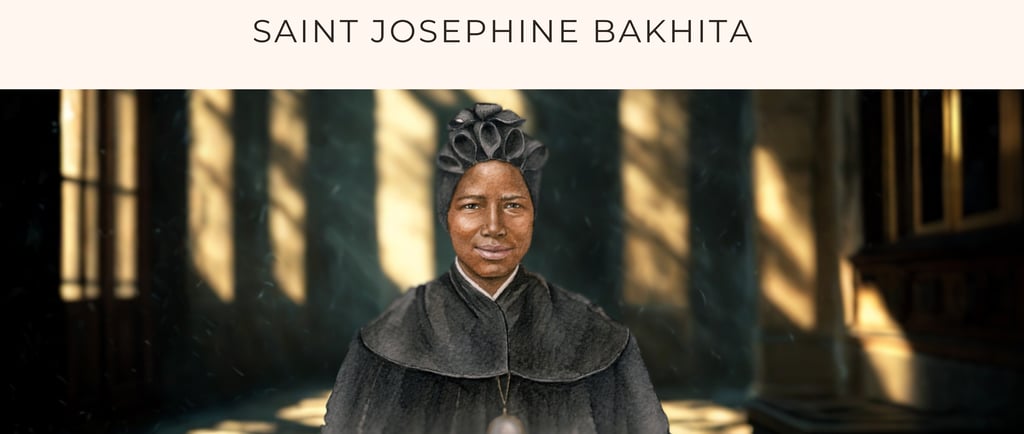
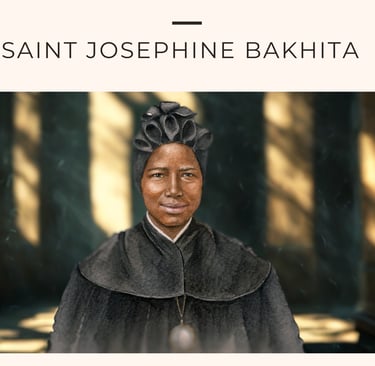
The story of Saint Josephine Bakhita is one of the most powerful modern testimonies of resilience, forgiveness, and the journey from the depths of human cruelty to the heights of spiritual freedom. And considering the priorities Pope leo XIV has been expressing, she is an amazing choice for patron saint of the WYD 2027 to be held in Seoul.
Early Life and Kidnapping
Born around 1869 in the Darfur region of Sudan, she lived a happy early childhood. However, her life changed forever when she was kidnapped by Arab slave traders at approximately age seven or eight.
The trauma of her abduction was so severe that she forgot her birth name. Her captors mockingly named her Bakhita, which means "Lucky" or "Fortunate" in Arabic.
Years of Captivity
Over the next twelve years, Bakhita was sold and resold multiple times. Her experience was marked by extreme physical and psychological suffering:
Forced Labor: She served various masters, including a Turkish general.
Scarification: She underwent a brutal ritual where 114 intricate patterns were cut into her skin with flour and salt rubbed into the wounds to ensure permanent scarring.
Human Rights Abuses: She frequently endured beatings and humiliation at the hands of her owners.
In 1883, she was bought by Callisto Legnani, the Italian consul in Khartoum. For the first time since her kidnapping, she was treated with kindness. When Legnani returned to Italy, Bakhita begged to go with him.
She was eventually given to the Michieli family to serve as a nanny. When the Michielis had to travel for business, they placed Bakhita and their daughter in the custody of the Canossian Sisters in Venice. It was here that Bakhita encountered Christianity.
The Legal Battle for Freedom
When the Michieli family returned to claim her, Bakhita refused to leave the convent. Supported by the sisters and the Patriarch of Venice, she took her case to court. The Italian court ruled that because slavery was illegal in Italy, and had been illegal in Sudan since before her birth, she had actually been free her entire life.
Life as a Religious Sister
Bakhita was baptized in 1890, taking the name Josephine Margaret Mary Isabetta. In 1893, she entered the novice house of the Canossian Daughters of Charity, and in 1896, she took her final vows.
For the next 50 years, she lived in Schio, Italy, serving her community as a:
Cook and Sacristan: Performing humble daily tasks.
Porter (Doorkeeper): Her gentle voice and constant smile earned her the nickname "la nostra Madre Moretta" (our little Black Mother).
"If I were to meet the slave-traders who kidnapped me and even those who tortured me, I would kneel and kiss their hands, for if that did not happen, I would not be a Christian and a religious today." — Saint Josephine Bakhita
Death and Canonization
Josephine Bakhita passed away on February 8, 1947. In her final days, she relived her trauma in her delirium, crying out to the nurses, "Please, loosen the chains... they are heavy!"
Beatified: May 17, 1992, by Pope John Paul II.
Canonized: October 1, 2000, by Pope John Paul II.
Patron Saint: She is the patron saint of Sudan and survivors of human trafficking.
Her feast day is celebrated on February 8th, which also serves as the International Day of Prayer and Awareness against Human Trafficking.
Her Confirmed Miracles
The miracle that led to her beatification in 1992 involved the healing of Tereza Cavalcante, a woman in Brazil.
The Condition: Tereza suffered from severe diabetic leg ulcers (gangrene) that would not heal. Medical professionals believed the situation was terminal or would require amputation.
The Intercession: Tereza and her community prayed to Josephine Bakhita for a cure.
The Healing: The ulcers disappeared completely and suddenly, leaving no medical explanation for the recovery. This was officially recognized by the Vatican as a miracle in 1991.
The second miracle, which cleared the way for her to be declared a saint in 2000, also took place in Brazil and involved the healing of Elisabete Micheloni.
The Condition: In 1992, Elisabete was suffering from a severe form of systemic lupus erythematosus (Lupus), a chronic autoimmune disease. Her condition had deteriorated to the point where her internal organs were failing.
The Intercession: Her family and the local parish sought the intercession of the then-Blessed Josephine Bakhita.
The Healing: Elisabete experienced a total and instantaneous recovery. Doctors who examined her later found no trace of the disease, and the Vatican's medical board confirmed that the healing could not be explained by science.
Faith
Sharing God's grace with joy and kindness.
Grace
© 2025. All rights reserved.