

Saint John Paul II
In honor of Pope John Paul II, creating the World youth day , and being announced as one of the saint patrons of the 2027 WYD Seoul
SAINTS
6/5/202612 min read
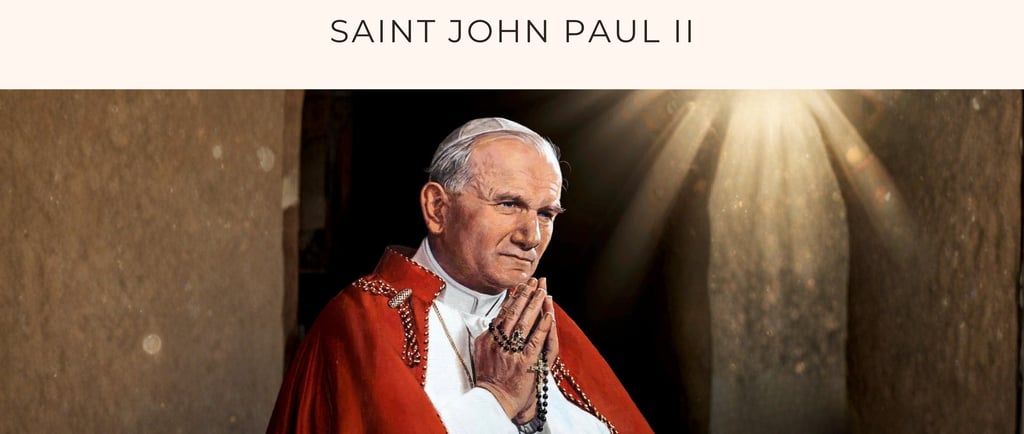
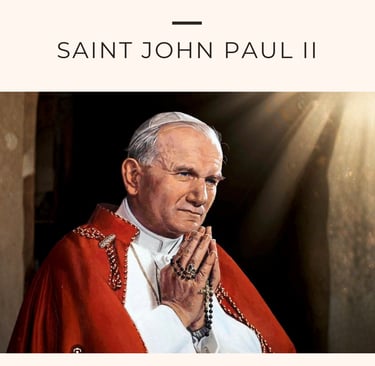
The Pilgrim Pope: Saint John Paul II
Karol Józef Wojtyła, who served as Pope John Paul II from 1978 to 2005, is among the most historically significant religious figures of the twentieth century. His influence extended across the domains of theology, international diplomacy, and cultural politics on a scale that few occupants of the Holy See have matched.
Born into a modest household in the Polish town of Wadowice in 1920, he rose through a Church operating under conditions of sustained political repression to become, at fifty-eight, the first non-Italian Pope in 455 years. His philosophical formation, his experience of totalitarian occupation, and his pastoral instincts combined to produce a pontificate of unusual intellectual and political coherence. The breadth of its impact, encompassing the collapse of the Soviet Bloc, the elaboration of a distinctive philosophical anthropology, and the global expansion of Catholic evangelisation, warrants sustained scholarly attention.
The present article traces the principal phases of his life and papacy: his formation in occupied Poland, his rapid ascent through the Polish Church under Communism, the major theological and geopolitical dimensions of his pontificate, and the contested character of his legacy. It draws on the established historiography of the period as well as Wojtyła's own published writings.
A Childhood Shaped by Grief and Grace
Karol Józef Wojtyła was born on 18 May 1920 in Wadowice, a market town some thirty miles southwest of Kraków. His father, Karol Wojtyła Senior, was a lieutenant in the Polish Army and a committed Catholic, whose influence on his son's religious formation is well attested in autobiographical sources. His mother, Emilia (née Kaczorowska), died of kidney and heart disease in 1929, when Karol was nine years old.
His elder brother Edmund, a physician, died of scarlet fever contracted from a patient in 1932. His father died of a heart attack in 1941, during the Nazi occupation, while the two were living in Kraków. By the age of twenty-one, Wojtyła had lost all immediate family members. Several of his later biographers, including George Weigel in Witness to Hope (1999), have noted that these losses appear to have reinforced rather than weakened his religious commitments, and that the theme of redemptive suffering occupies a prominent place in his subsequent philosophical and theological writings.
He later wrote, with characteristic restraint: "I was not at my mother's death, I was not at my brother's death, and now I was not at my father's death. At twenty, I had already lost all the people I loved." The observation is documented in multiple testimonies and is consistent with the account he gave in his late-career memoir Gift and Mystery (1996).
A note on his early social context: the town of Wadowice had a notable Jewish community, and Wojtyła formed close friendships across religious lines from an early age, most notably with the family of his classmate Jerzy Kluger. This early experience is considered relevant to his subsequent engagement with Catholic-Jewish relations, which culminated in his historic visit to the Western Wall in Jerusalem in 2000 and his repeated public condemnations of anti-Semitism.
Wojtyła's early intellectual and social profile was wide-ranging. He was an active participant in theatrical productions, a proficient linguist, and an athlete who played as a goalkeeper and later became an accomplished skier and mountaineer. He matriculated from secondary school in 1938 with distinction and enrolled at the Jagiellonian University in Kraków to read Polish language and literature. The German invasion of Poland in September 1939, and the subsequent occupation, resulted in the forced closure of the university and a radical disruption of his academic formation.
Survival Under Occupation: The Making of a Priest
The German occupation of Poland was characterised by the systematic targeting of Polish intellectual, professional, and religious elites. In order to remain in Kraków and avoid deportation as forced labour to Germany, Wojtyła was required to hold registered employment. For much of the war he worked at a limestone quarry in Zakrzówek and subsequently at the Solvay chemical factory, where he undertook manual labour on night shifts. In 1944 he was struck by a German military vehicle and briefly hospitalised.
Simultaneously, he pursued theological formation through underground channels. He was influenced by the writings of the lay mystic Jan Tyranowski and participated in the clandestine Rhapsodic Theatre, which staged Polish literary works in private homes as a form of cultural resistance. In 1942 he was admitted to an illegal seminary operating under the authority of the Archbishop of Kraków, Cardinal Adam Stefan Sapieha. The Polish Catholic clergy were by this point subject to systematic arrest and execution by the occupying authorities, who correctly identified the Church as a structurally important institution of Polish national identity.
In August 1944, as German forces conducted purges of young men in Warsaw following the outbreak of the Warsaw Uprising, Cardinal Sapieha relocated all seminarians to the Archbishop's residence in Kraków, where they remained concealed until Soviet forces liberated the city in January 1945. This sequence of events, including extended manual labour, participation in cultural resistance, and clandestine theological formation, produced a formation markedly different from the conventional seminary experience of the period. Scholars of his later philosophical output have argued that his direct encounter with the political and physical subordination of the human person under totalitarian governance provided the experiential basis for his subsequent engagement with personalist philosophy and the theology of human dignity.
A Life in Dates
1920 — Born on 18 May in Wadowice, Poland, to Karol Wojtyła Sr. and Emilia Kaczorowska.
1929–1941 — Loses his mother, his only brother Edmund, and his father in successive bereavements. Enrolls at the Jagiellonian University; studies interrupted by Nazi invasion.
1942–1944 — Enters clandestine seminary in occupied Kraków; works in a quarry and chemical plant to avoid deportation. Hides in the Archbishop's palace during the German purges of 1944.
1946 — Ordained to the priesthood on 1 November by Cardinal Sapieha. Sent to Rome to complete doctoral studies in theology.
1958 — Appointed auxiliary Bishop of Kraków by Pope Pius XII, becoming the youngest bishop in Poland at the time.
1962–1965 — Participates in all four sessions of the Second Vatican Council; plays a significant role in drafting the pastoral constitution Gaudium et Spes.
1964 — Named Archbishop of Kraków by Pope Paul VI.
1967 — Elevated to the College of Cardinals.
1978 — Elected Pope on 16 October, taking the name John Paul II, the first non-Italian pontiff in 455 years.
1979 — Returns to Poland in a nine-day pilgrimage, drawing crowds of millions and providing significant moral support to the nascent Solidarity movement.
1981 — Survives an assassination attempt in St Peter's Square. Later visits his attacker, Mehmet Ali Ağca, in prison.
1985 — Establishes World Youth Day, which becomes a global gathering of millions of young Catholics.
1991–2000 — Presides over a Church reshaped by the fall of Communism; issues major documents including Veritatis Splendor, Evangelium Vitae, and the universal Catechism. Leads the Catholic Church's Great Jubilee of the year 2000.
2005 — Dies on 2 April in his Vatican apartment. Four million people attend the funeral. Crowds chant "Santo Subito!" (Sainthood Now!).
2014 — Canonised as a Saint by Pope Francis on 27 April, alongside Pope John XXIII.
The Papacy, 1978–2005. A Pontificate of Global Scope
On the evening of 16 October 1978, following the brief conclave convened after the death of Pope John Paul I, Wojtyła was elected to the papacy. He was fifty-eight years old and the first non-Italian to hold the office since the Dutch-born Adrian VI in 1522. His election was widely regarded as historically significant, not least because it came from a nation that remained under Communist governance, introducing a significant geopolitical dimension to the papacy from the outset.
The pontificate that followed was notable for its scale and output. John Paul II visited 129 countries, a record for any head of state. He issued 14 encyclicals, published five works of theology, authored three dramatic texts and a volume of poetry, and canonised more saints than all previous popes combined. He was fluent in eight languages and engaged with a wide range of world leaders, including Mikhail Gorbachev, Fidel Castro, and Yasser Arafat. The scholarly literature on his pontificate tends to organise its principal themes under four broad headings: his contribution to the collapse of Soviet Communism, his theological anthropology of the body, his engagement with young Catholics globally, and his public enactment of forgiveness and witness.
The Collapse of the Soviet Bloc
John Paul II's role in the collapse of Soviet-aligned Communism in Eastern Europe is among the most extensively debated aspects of his pontificate. When he returned to Poland in June 1979, the Communist government, calculating that a refusal would generate greater political instability, permitted the visit. Over nine days, an estimated ten million Poles participated in his public Masses and gatherings. At an open-air Mass in Victory Square, Warsaw, he delivered the address in which he stated: "It is not possible to understand the history of the Polish nation without Christ." The gathering crowd responded with the chant: "We want God, we want God."
Within twelve months, the independent trade union Solidarity, led by Lech Wałęsa, had registered approximately ten million members across Poland, making it the largest civil society movement in the history of the Eastern Bloc. The relationship between the papal visit and the emergence of Solidarity is well established in the historiography, though the precise causal weight assigned to it varies among scholars. Zbigniew Brzeziński, national security advisor to President Carter, described the 1979 visit as "the beginning of the end of the Soviet empire." Mikhail Gorbachev, in a 1992 interview, stated that the political transformations in Eastern Europe "would have been impossible without the presence of this Pope."
Historians who emphasise structural factors, including the systemic economic failures of the Soviet model and the internal contradictions of the Brezhnev doctrine, do not necessarily contest these assessments but situate them within a broader explanatory framework. The consensus position in the scholarly literature holds that John Paul II contributed materially to the erosion of the legitimating ideology of Soviet Communism, accelerating a process of delegitimisation that structural factors alone cannot fully account for.
The Theology of the Body
Between September 1979 and November 1984, John Paul II delivered 129 Wednesday catecheses later compiled and published as Theology of the Body: Human Love in the Divine Plan. The series received limited coverage in the secular press during its delivery. Subsequent theological scholarship has assessed it as a significant contribution to Catholic anthropology.
The core argument draws on phenomenological method, scriptural exegesis, and the personalist philosophical tradition to argue that the human body, and the sexual difference between man and woman, is not peripheral to human identity but constitutes what Wojtyła termed a "nuptial meaning": a fundamental capacity for self-giving that reflects, in the created order, the relational character of the divine. The framework was intended to engage, on philosophical rather than purely juridical grounds, the questions about sexuality, contraception, and marriage that had become contentious in the aftermath of Humanae Vitae (1968).
Christopher West, a prominent interpreter of the corpus in the English-speaking world, has characterised it as a comprehensive philosophical alternative to the sexual revolution of the 1960s. This assessment has been contested by some theologians who regard it as overreaching. What is less contested is its influence on the formation of Catholic clergy and laity in the decades since its publication, particularly in North America and parts of Latin America.
The 1981 Assassination Attempt and Its Aftermath
On 13 May 1981, at approximately 5:17 p.m., a Turkish national named Mehmet Ali Ağca opened fire on the Pope as his vehicle moved through a crowd in St Peter's Square. Two bullets struck Wojtyła: one passed through his abdomen, narrowly missing the aorta; a second wounded his left hand. He was transported to the Agostino Gemelli University Hospital, where he underwent emergency surgery lasting approximately five hours. His survival was described by attending physicians as clinically uncertain at several points during the procedure.
John Paul II subsequently attributed his survival to the intercession of Our Lady of Fátima, noting that the shooting took place on 13 May, the feast of the first Fátima apparition of 1917. The bullet extracted from his body was later incorporated into the crown of the statue of Our Lady at the Fátima shrine in Portugal. On 27 December 1983, he visited Ağca in his cell at Rome's Rebibbia Prison, where the two held a private conversation of approximately twenty minutes. The Pope stated publicly thereafter: "I spoke to him as a brother whom I have pardoned, and who has my complete trust."
The question of who commissioned the attack has not been definitively resolved. Investigative proceedings in Italy and subsequent inquiries considered the involvement of Bulgarian intelligence services and, by extension, the Soviet KGB, as well as Turkish ultra-nationalist networks. Ağca gave contradictory accounts at various points in his imprisonment and has not provided a legally conclusive explanation of his motives. He was released from an Italian prison in 2000 and from a Turkish prison in 2010. The Pope's decision to visit him was interpreted at the time, and has been interpreted in subsequent scholarship, as a public enactment of his theological position on forgiveness as a moral and theological category distinct from political accommodation.
World Youth Day and Engagement with Young Catholics
In 1985, coinciding with the United Nations International Year of Youth, John Paul II inaugurated World Youth Day as a regular international gathering of young Catholics. The first international event was held in Buenos Aires in 1987, drawing an estimated one million participants. Subsequent gatherings grew substantially in scale: the 1995 event in Manila attracted estimates of between four and five million attendees, and the 1997 gathering in Paris drew over one million to an overnight vigil. The event has continued biannually under subsequent pontiffs.
John Paul II's capacity to attract large and engaged audiences among young people was a notable feature of his pontificate and has been the subject of sociological as well as pastoral commentary. Several analysts have attributed it to the combination of intellectual seriousness and physical accessibility he projected; his background as an athlete, mountaineer, and theatre practitioner distinguished him from the conventional image of the scholarly cleric. His directness in addressing young people, including his frequently cited injunction to "not be satisfied with mediocrity," was regarded by many observers as reflecting a pastoral style that treated young audiences as capable of serious moral and intellectual engagement.
Decline and Death, 1995–2005
From the mid-1990s, John Paul II's health declined progressively. He had been diagnosed with Parkinson's disease, a diagnosis the Vatican did not initially disclose publicly. The visible effects of the disease, including tremors, increasing difficulty of speech, and reduced mobility, were apparent to observers from approximately 1994 onwards. His decision to continue his public ministry despite these conditions, including international travel until 2004, was consistent with his published theological position on the dignity and social significance of the elderly and the sick.
Cardinal Joseph Ratzinger, his principal theological collaborator and eventual successor, later wrote that Wojtyła held that the papal office, understood as a spousal bond with the Church, could not be renounced as a matter of canonical principle. This was not a position universally shared in canon law scholarship, but it was one to which John Paul II adhered. He continued to preside at public liturgies from a wheelchair and to appear at his Vatican window for the Angelus address throughout his final years.
On 2 April 2005, the liturgical feast of Divine Mercy, a feast he had himself incorporated into the universal calendar of the Catholic Church in 2000, John Paul II died in his Vatican apartment. He was eighty-four years old. Those present reported his final audible words as spoken in Polish: "Let me go to the Father's house."
The funeral, held on 8 April 2005, was attended by an estimated four million people in Rome and followed by hundreds of millions via broadcast media. Over 200 nations sent official delegations, making it among the most extensively attended state funerals on record. Portions of the crowd chanted "Santo Subito!" (Sainthood Now!), a spontaneous popular acclamation that is generally regarded as having contributed to the pace of the subsequent canonisation process.
Legacy
A balanced scholarly assessment of the legacy of John Paul II must attend to both the extent and the limits of his pontificate. His public positions on contraception, the ordination of women, and homosexuality aligned closely with traditional Catholic teaching and placed the papacy in an adversarial relationship with significant currents of Western liberal thought. Within the Church, his governance style was centralising, reinforcing the authority of Rome at the expense of episcopal collegiality. Most significantly, his management of the clerical sexual abuse crisis has been subject to sustained critical scrutiny. The protective culture within clerical institutions that enabled abuse was not of his making, but the evidence that meaningful corrective action was not taken during his pontificate, despite knowledge of widespread abuse, represents a serious institutional failure that scholarship has begun to document systematically. These observations are not incidental to an evaluation of his legacy. They bear directly on the welfare of those harmed and on the institutional credibility of the Church he led.
Within those limitations, the record of the pontificate is nonetheless substantial. His contribution to the delegitimisation of Soviet Communism has been addressed above. In the domain of interreligious relations, he visited the Great Synagogue of Rome in 1986, the first Pope to do so, and addressed Jews as the Church's "elder brothers" in faith. He issued formal apologies on behalf of the Church for a range of historical wrongs, including conduct during the Inquisition, the Church's treatment of Galileo, and the failures of Catholics during the Shoah. He expanded the canon of saints more than any predecessor, deliberately drawing on the full geographical breadth of Catholicism rather than concentrating canonisations in the European tradition.
He was beatified by Pope Benedict XVI on 1 May 2011, approximately six years after his death, and was canonised by Pope Francis on 27 April 2014 alongside Pope John XXIII, in a ceremony attended by an estimated 800,000 people. The pace of this process was notable. The decision to canonise a figure whose pontificate remained within living memory and whose historical assessment was still in progress was itself a significant ecclesiastical act, reflecting a particular institutional reading of his significance.
The wider question of his cultural and pastoral influence is more difficult to quantify. Multiple generations of Catholics in various national contexts underwent formative religious experiences in connection with his pontificate, whether through World Youth Day, through direct engagement with his theological writings, or through the prolonged public visibility of his final years. The sociological dimensions of this influence remain an active area of research in the study of contemporary Catholicism.
Faith
Sharing God's grace with joy and kindness.
Grace
© 2025. All rights reserved.