

Saint Andrew Kim TaeGon 김대건
In homage to Saint Andrew Kim TaeGon, first Korean Priest, and Saint. He is one of the 5 patron Saints of WYD 2027 Seoul
SAINTS
5/29/20262 min read
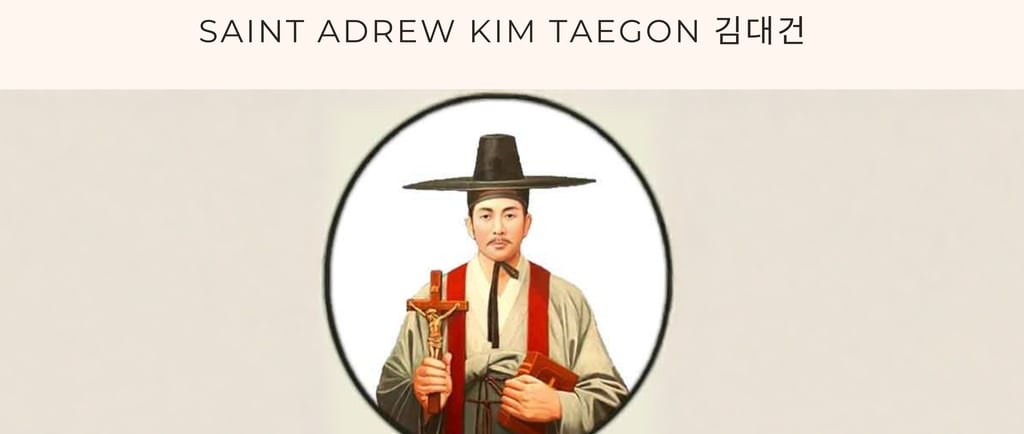
The Pioneer of Faith: Saint Andrew Kim Taegon
Saint Andrew Kim Taegon (1821–1846) holds a singular place in history as the first native-born Korean Catholic priest. His life was a whirlwind of underground diplomacy, perilous sea voyages, and an unwavering commitment to his faith during an era of brutal religious persecution in Korea.
Early Life and Calling
Born into a family of devout converts in Solmoe, Korea, Andrew grew up in the shadow of the Joseon Dynasty's strict isolationism. Faith was a dangerous legacy; his great-grandfather and father were both martyred for their beliefs.
1836: At just 15 years old, Andrew was selected by visiting French missionaries to study for the priesthood.
The Journey: Since there were no seminaries in Korea, he walked over 1,300 miles to Macau, China, to begin his studies under the Society of Foreign Missions of Paris.
After being ordained in Shanghai in 1845, Father Kim faced the monumental task of returning to his homeland, where being a Christian was essentially a death sentence.
The Return: He successfully crossed the Yellow Sea, returning to Korea to begin his ministry in secret.
The Role: He acted as a bridge between the local "underground" church and European missionaries, often using his knowledge of geography and languages to scout safe entry points along the coast.
Martyrdom and Legacy
His ministry lasted barely a year. In 1846, while attempting to arrange for more missionaries to enter the country, he was arrested.
"This is my last hour of life, listen to me attentively: if I have held communication with foreigners, it has been for my religion and for my God. It is for Him that I die." — Andrew Kim Taegon, shortly before his execution.
The Execution: He was tortured and eventually beheaded near Seoul on September 16, 1846, at the age of 25.
Canonization: He was canonized by Pope John Paul II in 1984 during a historic ceremony in Seoul, along with 102 other Korean martyrs.
Unlike many other saints, Andrew Kim Taegon and his fellow Korean martyrs were canonized without the standard requirement of medical or physical miracles.
In the Catholic Church, there is a traditional exception for those killed specifically for their faith. Here is how his path to sainthood worked:
1. The "Martyrdom Exception"
In the process of canonization, a candidate usually needs one miracle for beatification and a second for canonization. However, if a person is declared a Martyr (died in odium fidei, or "in hatred of the faith"), the requirement for a miracle for beatification is typically waived. Their death itself is considered the "miracle" of supreme witness.
2. The 1984 Papal Dispensation
When Pope John Paul II prepared to canonize Andrew Kim Taegon and 102 other martyrs during his 1984 visit to South Korea, he granted a special dispensation.
The Reason: The Pope recognized the extraordinary strength of the Korean Church, which was founded almost entirely by laypeople and sustained through a century of brutal persecution.
The Act: He waived the requirement for the final miracle usually needed for canonization. This allowed the 103 martyrs to be elevated to sainthood en masse to celebrate the bicentennial of the Korean Catholic Church.
3. The "Moral Miracle"
While there aren't specific "medical" miracles (like a sudden cure of a disease) tied to his canonization file, the Church often refers to the "Moral Miracle" of the Korean Church.
The fact that a small group of laypeople brought books from China, converted themselves, and maintained a vibrant, growing community for decades without any priests or sacraments, all while under the threat of death, is considered by many theologians to be a miraculous work of the Holy Spirit.
Faith
Sharing God's grace with joy and kindness.
Grace
© 2025. All rights reserved.